How Dentists Can See Exactly Where They Rank on Local Maps
How Dentists Can See Exactly Where They Rank on Local Maps
For many dental practice owners, checking their local search visibility involves a simple, habitual ritual: sitting at their desk, opening a smartphone, and typing “dentist near me” into Google. When their practice appears at the very top of the Map Pack, they breathe a sigh of relief. They assume their digital marketing is firing on all cylinders. Unfortunately, this is what SEO experts call a “false positive,” and it is one of the most dangerous misconceptions in healthcare marketing.
Section 1: The Proximity Paradox
The reality of Google’s algorithm is heavily centered on one primary factor: your physical location at the moment of the search. Research consistently shows that proximity is the #1 factor in Map Pack rankings. As noted by industry experts at Hibu, “Proximity plays a major role in your Map Pack ranking. Google tries to show people dentists who are physically close and contextually relevant.”
This creates the Proximity Paradox. Because you are searching while sitting inside your own office, Google’s GPS data places you exactly at the point of origin for your business. Of course you are #1 there. But what happens when a potential patient searches for an “emergency dentist” from a coffee shop three miles away? Or from a residential neighborhood on the other side of the highway? In many cases, a dentist who is #1 in their office might be #15 or even #50 just a few blocks away.
This “hyperlocal” visibility is the true battlefield. For a dental practice to thrive, it cannot rely on being visible only to the people standing in its parking lot. You must understand how your visibility decays as distance increases. If you don’t know exactly where your “visibility border” ends, you are essentially flying blind, unaware that you are invisible to 80% of your local catchment area.
Section 2: Why Traditional Rank Tracking Fails Dentists
For years, SEO agencies provided dentists with PDF reports showing a single number for their keywords. It might say “Dentist in [City Name]: Rank #2.” While this looks good on paper, it is a fundamentally flawed metric for local search. Traditional rank tracking typically uses “City-Level” data, which simulates a search from the geometric center of a city or a single zip code.
Standard rank tracking fails to measure real local SEO success because it ignores the granular nature of the Google Maps grid. A dental practice is not a national e-commerce brand; it is a local destination. A single “average” rank number is useless because visibility is non-linear. A dentist might be the undisputed king of the North end of town but completely absent in the South end due to a competitor’s proximity or a lack of localized signals.
To get a real sense of your standing, you need local seo tools that can bypass the limitations of city-wide averages. Without a google maps rank tracker, you are looking at a flattened version of a three-dimensional problem. If your marketing agency is still sending you spreadsheets with static numbers, they are missing the “where” in “where do I rank?” Understanding the spatial distribution of your rankings is the only way to identify which neighborhoods are being surrendered to your competitors.
Section 3: The Solution: Geo-Grid Rank Tracking Explained
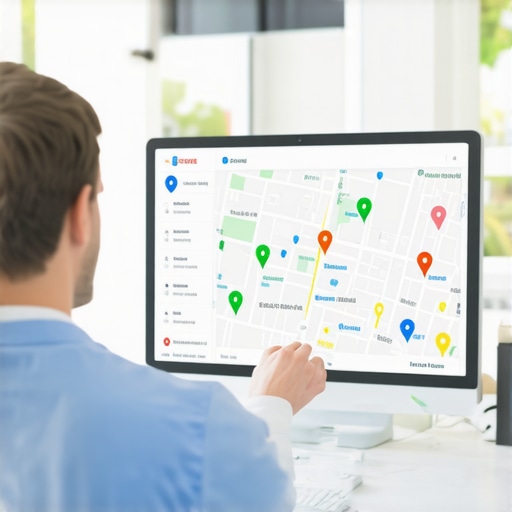
The only way to see the truth is through Geo-Grid Rank Tracking. Unlike traditional tracking, a geo-grid tool places a virtual “mesh” or grid over your service area. Each node on the grid represents a specific GPS coordinate. The tool then performs a search from every single one of those coordinates simultaneously.
The result is a visual “heat map” of your performance. You will typically see a series of dots ranging from green (Rank 1-3) to yellow (Rank 4-10) to red (Rank 11+). This visual representation is a game-changer for dental marketing. It allows you to see exactly where your “green zone” ends. If you see a sea of green to the West but a wall of red to the East, you have identified a specific geographic weakness. This is often the first step in The 15-Minute Google Maps Audit That Finds Hidden Ranking Blocks.
Tools like Local Falcon or Local Dominator provide these insights by simulating real-world user behavior across a broad area. By using a google maps ranking service that utilizes geo-grid technology, you can stop guessing. You can see if a specific highway or river is acting as a “ranking barrier” and adjust your strategy accordingly. This data-driven approach moves SEO from a vague concept to a precise logistical operation.
Section 4: 7 Steps to Dental SEO Mastery
Once you have visualized your ranking gaps, you need a tactical plan to fill them. Based on extensive research into high-performing dental groups, here is a 7-step checklist to dominate your local grid:
- 1. Conduct a Baseline Geo-Grid Audit: Use a tool to see your current “heat map.” This tells you your starting point and identifies “dead zones.”
- 2. Claim and Verify Your Google Business Profile (GBP): It sounds basic, but many practices have “unclaimed” duplicate profiles that split their ranking power. Ensure you have one, clean, verified profile.
- 3. Audit NAP Consistency: Your Name, Address, and Phone number must be identical across the web. Google rewards consistency with trust. If your suite number is missing on Yelp but present on your website, it creates friction in the algorithm.
- 4. Optimize Primary and Secondary Categories: Choosing “Dentist” is a start, but adding “Cosmetic Dentist,” “Pediatric Dentist,” or “Dental Implants Periodontist” as secondary categories helps you appear in more specific, high-intent searches. This is a core part of google business profile optimization.
- 5. Define and Update Service Areas: Even if you are a brick-and-mortar office, specifying the neighborhoods you serve in the GBP dashboard helps Google associate your practice with those specific geo-locations.
- 6. Add Specific Dental Services: Don’t just list “General Dentistry.” Create individual service entries for Invisalign, Root Canals, Veneers, and Teeth Whitening. Use the description fields to include local keywords naturally.
- 7. Maintain a Posting Frequency: You should be posting to your GBP at least twice a month. Treat it like a “mini-social media” platform. Share before-and-after photos (with consent), office updates, and patient testimonials.
To truly rank google business profile effectively, consistency is more important than intensity. A practice that updates its profile weekly will almost always outrank one that does a massive update once a year and then forgets it.
Section 5: The 2026 Engagement Signals Dentists Ignore
As we move toward 2026, the traditional pillars of SEO – keywords and citations – are being augmented by user engagement signals. Google’s algorithm is becoming increasingly sophisticated, looking not just at what your profile says, but how users interact with it. If you are wondering Why Your Business Profile Is Stuck on Page Two While Competitors Thrive, the answer likely lies in these invisible signals.
One of the most critical emerging factors is Profile Dwell Time. Google tracks how long a user stays on your profile. If a patient clicks your profile, looks at 15 photos of your office, reads three reviews, and then clicks “Call,” that is a massive signal of relevance. Conversely, if they click and immediately bounce back to the search results, Google perceives your practice as a poor match for that query.
Furthermore, Why Map Pin Taps Are the Most Ignored Ranking Signal in 2026 is a topic every dentist should study. When a user is browsing the map and taps your specific pin, pans the map to see your location relative to their commute, or zooms in on your street view, these are high-intent engagement signals. Google interprets these “micro-interactions” as proof of your practice’s popularity and authority.
Additionally, we must consider the rise of AI Search Visibility. As Cole Nisson recently noted on LinkedIn, “Reviews not only help you rank higher, they also build trust with potential new patients.” But in 2026, reviews also feed the Large Language Models (LLMs) used by ChatGPT, Perplexity, and Google’s own AI Overviews. If your reviews frequently mention “painless dental implants in [City Name],” AI search engines are more likely to recommend you when a user asks, “Who is the best dentist for implants near me?” This is the new frontier of google business profile seo.
To stay ahead, you must move beyond basic Ranking Signals Unlocked: Evening Insights for SEO Optimization and focus on generating real human interaction on your profile.
Section 6: Troubleshooting “Dead Zones” in Your Grid
If your geo-grid shows a “dead zone” in a wealthy neighborhood just four miles away, how do you fix it? You cannot move your office, but you can move your digital relevance. This is where hyperlocal content and advanced technical SEO come into play.
First, consider creating neighborhood-specific landing pages on your website. If you want to rank in “Oak Creek Estates,” write a blog post about dental health for families in Oak Creek or sponsor a local Oak Creek little league team and post about it. Second, implement How Specific Geo-Targeted Schema Actually Changes Your Map Position. By adding LocalBusiness Schema with specific geo-coordinates and hasMap properties to your site, you provide Google with the technical proof of your local relevance.
Niche citations also help. Getting listed in a local neighborhood directory or a “Best of [Neighborhood]” list carries more weight for Map rankings than a generic national directory. If you find your rankings are lagging, consider using a professional google maps ranking service to perform a deep-dive audit of your local entity associations.
Section 7: Conclusion & CTA
The days of “set it and forget it” SEO are over. For dentists to truly dominate the Local 3-Pack, they must embrace the transparency of geo-grid tracking and the complexity of modern engagement signals. You can no longer afford to rely on “false positive” searches from your office chair. You need to know exactly where you rank, street by street, and neighborhood by neighborhood.
Are you ready to see the truth about your rankings? Perform a geo-grid audit today to identify your practice’s “dead zones.” If you’re ready to dominate your local market and turn those red dots green, contact Mohit Kosta, your expert in healthcare SEO, to build a strategy that drives real patient growth.